Disclosure: This page contains affiliate links, and we may earn a commission if you buy through them, at no extra cost to you. Deal terms change over time, so treat the current AppSumo listing as the final word on price and limits.
Opening
A security scanner subscription or a code audit from an agency typically runs into thousands of dollars a year once you add up recurring checks across even a handful of small apps. Vibe App Scanner lists a retail comparison price of $240, positioned as what similar scanning coverage would otherwise cost. The lifetime deal on AppSumo starts at $49 for the entry tier. If you are shipping apps built with AI coding tools and currently have no security review step at all, or you are paying for scattered manual checks, this is a one-time alternative worth looking at closely before you commit.
What it is
Vibe App Scanner is a security scanning tool built specifically for apps made with AI coding tools like Lovable, Base44, Replit, Claude, and Codex. Instead of a generic header checklist, it scans a live app the way an attacker would: inspecting JavaScript, discovering APIs, testing database access rules, and checking authentication behavior.
The founders come from a code and security audit background and built the tool around patterns they kept finding in real client audits: publicly readable Supabase tables, service-role keys sitting in frontend code, APIs that trust whatever user ID they are handed, and login checks that stop at "is this person authenticated" without checking what that person should actually be allowed to see.
Beyond security, the listing says it also checks performance, accessibility, SEO, compliance, email security, and AI search visibility, so the scan covers more than just the security angle alone.
Key facts
One-time price: $49 (Tier 1), $119 (Tier 2), $249 (Tier 3)
Retail comparison given: $240
Refund window: 60 days, refundable
Tier structure: three tiers, direct tier selection (no stacking mentioned in the listing)
Integrations named: Google Firebase, Stripe, Supabase
Best for (per listing): developers, solopreneurs, agencies
Company founded: November 21, 2025, based in Ontario, Canada, listed as a 1-10 person bootstrapped startup
What the payback looks like
Using the $240 retail comparison the listing gives, that works out to $20 a month in the scenario the vendor is comparing against. At $49, Tier 1 pays for itself in under three months if you would otherwise be paying anything close to that comparison figure. That is a fast payback by most standards.
Tier 2 at $119 and Tier 3 at $249 take longer to break even against that same $240 figure, so they only make sense if you actually need the higher scan volume or website count those tiers unlock, not just because the price looks like a good deal on its own.
What you actually get
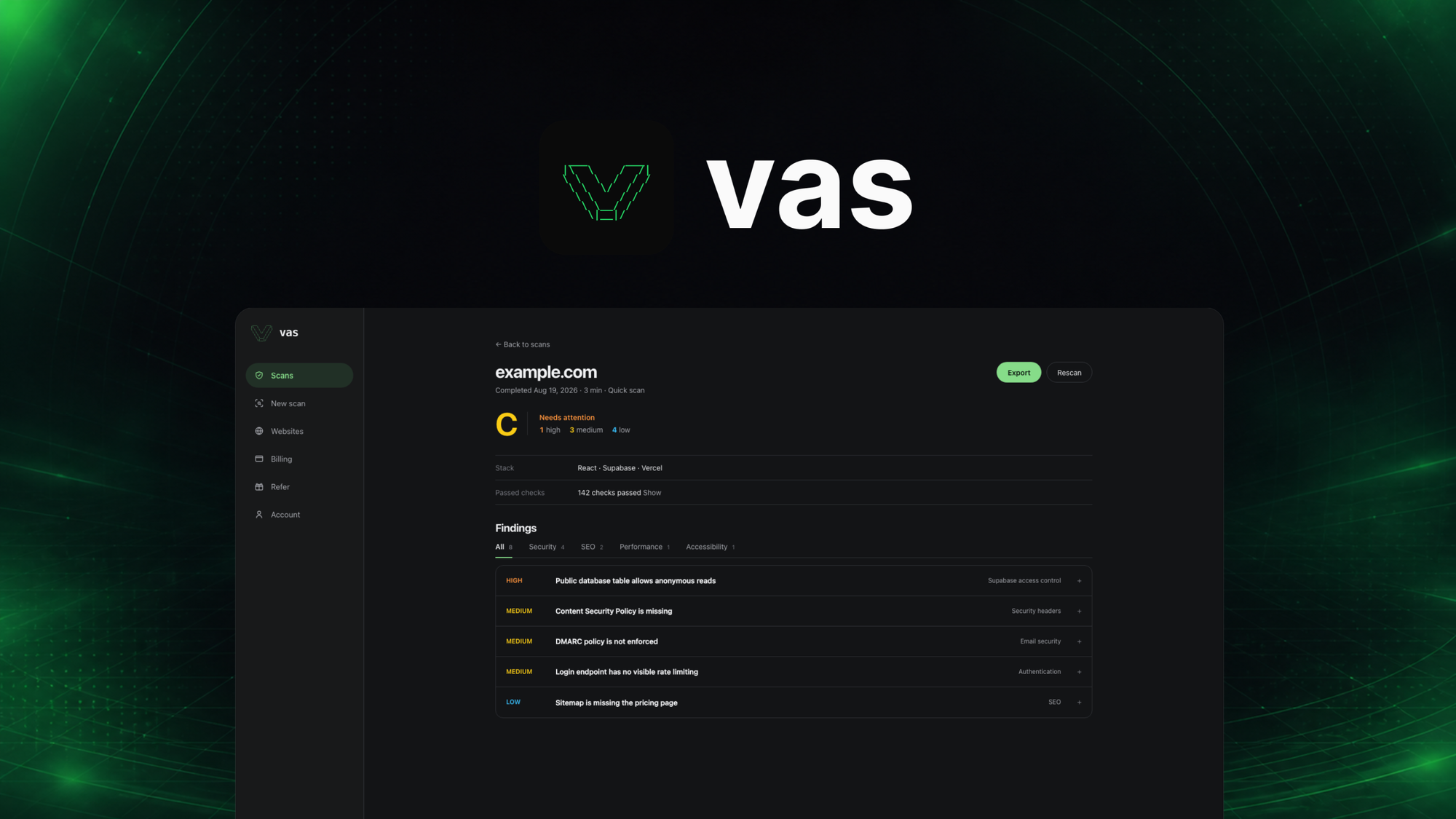
Scanning that understands AI-built stacks. The scanner auto-detects your stack, React, Supabase, Vercel, and more than 20 platforms according to the listing, and runs over 150 checks tuned specifically for the mistakes AI coding tools tend to introduce. This matters because a generic scanner that does not know a Supabase anon key is supposed to be public, while a service-role key absolutely is not, will either miss real issues or bury you in false alarms.
Authenticated flow testing. You can add login credentials so the scanner checks what a signed-in user can access, not just what a public visitor sees. Access-control bugs frequently hide behind a login wall, so this closes a real gap that a surface-level scan would miss.
Findings ranked by severity, explained in plain English. Instead of a raw vulnerability name and a link to a technical article, each finding comes with a severity ranking, a label describing what was caught, and a plain-English explanation of why it matters and what an attacker could actually do with it.
Copy-paste remediation code. Every finding includes ready-to-use fix code meant to be pasted directly into your AI coding tool or editor, along with the raw JSON evidence behind the finding if you want to verify it yourself.
Progress tracking across scans. You can track scans over time, watch your security score change as you fix issues, and compare findings across different deploys or environments to catch new problems as soon as they show up.
Tiers and limits
Tier 1, $49: 15 scans per month, 3 websites, email breach monitoring, weekly scan automation, MCP access, API access, full on-demand scanning, copy-paste fixes.
Tier 2, $119: 50 scans per month, 10 websites, same feature set as Tier 1 otherwise.
Tier 3, $249: 150 scans per month, unlimited websites, same feature set as Tier 1 and 2 otherwise.
The tiers scale by scan volume and website count, not by unlocking different features. Every listed capability, weekly automation, MCP access, API access, on-demand scanning, and remediation code, appears to be included even at Tier 1. The main decision is whether 3 websites and 15 scans a month covers what you actually run. This deal uses direct tier selection rather than stackable codes, so buy the tier that matches your real usage rather than planning to stack up from the cheapest option later. If you want a general refresher on how AppSumo structures these purchases, our guide on AppSumo codes and stacking covers how that usually works across different deals.
Things to weigh
The company was only founded in November 2025, so there is no multi-year track record to point to. That does not mean the tool is unreliable, but it is worth factoring into how much you rely on it for anything mission-critical in year two or three.
The website limit is the main practical constraint. If you manage client work or run several products, 3 websites on Tier 1 will not stretch far, and you would need Tier 2 or Tier 3 to cover a real agency workload.
The scan volume caps mean this is not built for constant, high-frequency scanning across a large number of properties. Weekly automation plus 15 scans a month on Tier 1 is enough for periodic checks on a small number of apps, not continuous monitoring at scale.
Before you buy
Confirm the integrations you actually use, Google Firebase, Stripe, or Supabase, match what your app is built on, since those are the only three named in the listing.
Check whether your payment method works for a direct AppSumo purchase before assuming it will go through.
If you plan to test authenticated flows, make sure you are comfortable handing the scanner login credentials for a staging or test account rather than a production admin account.
Decide up front whether Tier 1's 3-website limit fits your actual usage, since correcting for undersizing later means buying a second license rather than a simple upgrade path.
Who it suits, and who should look elsewhere
This fits well if you are:
A solo developer or small team shipping apps built primarily with AI coding tools and want a security pass before launch.
An agency doing client work where a quick, understandable vulnerability scan plus fix code speeds up your own audit process.
Someone who currently has no security review step at all and wants a low-cost way to add one.
Look elsewhere if you are:
Running security-critical infrastructure that needs continuous monitoring across many properties beyond what these scan caps allow, where a dedicated subscription-based security platform with unlimited scanning may serve you better long term.
Part of a team with in-house security engineers who already run deeper, more customized testing than an automated scanner covers.
Verdict
For $49, Tier 1 is a low-risk way to add a security check to a workflow that currently has none, especially if you are shipping apps built with Lovable, Replit, Claude, or similar tools where implementation details are easy to overlook. The explanation-plus-fix-code format is the strongest part of the offer, since it turns a scan result into something you can actually act on without a security background.
The tier decision matters more than the price does. If you run more than a couple of sites or need more than 15 scans a month, price out Tier 2 or Tier 3 honestly against what you would spend on the comparison subscription before assuming the cheapest tier is the better deal.
As with any young company on a lifetime deal, redeem your code as soon as you buy it, since AppSumo codes expire, and use the 60-day refund window to actually run scans on your real apps before the decision becomes final. If you want a broader view on evaluating these purchases before committing, our piece on lifetime deal versus subscription is a useful side read.
Not sure yet?
Run this deal through our free scorecard. Seven checks, a payback calculator, and a plain verdict on whether to buy.
Get the Lifetime Deal Scorecard, free
FAQ
Does Vibe App Scanner work with any tech stack?
The listing says it auto-detects React, Supabase, Vercel, and more than 20 platforms out of the box, with named integrations for Google Firebase, Stripe, and Supabase.
Can it test pages that require login?
Yes. You can add optional login credentials so the scanner checks authenticated user flows and access-control issues that only show up once signed in.
What happens after a vulnerability is found?
Each finding comes with a severity ranking, a plain-English explanation of the risk, and copy-paste remediation code meant to be pasted into your AI coding tool or editor.
Do the tiers unlock different features?
Based on the listing, all three tiers include the same feature set, weekly automation, MCP access, API access, and remediation code. The difference is scan volume per month and number of websites covered.
Is there a refund window?
Yes, the listing states refunds are available up to 60 days after purchase.
Does it check anything beyond security?
According to the founders, it also checks performance, accessibility, SEO, compliance, email security, and AI search visibility.