Disclosure: We may earn an affiliate commission if you purchase through this page, at no extra cost to you. Deal terms can change, so the current AppSumo listing is authoritative.
Replace a recurring documentation bill
A $65 monthly documentation subscription costs $780 a year. That is the GitBook comparison one customer gives in the pasted reviews, rather than an independently verified pricing quote. Against that benchmark, Documentation.AI starts at $69 for lifetime access.
The potential saving matters if you already pay to publish product documentation, API references, or a help center. You still need to migrate content and check that publishing works with your workflow. But for a small team, replacing that recurring bill with a one-time purchase could leave considerably more budget for other tools.
What it is
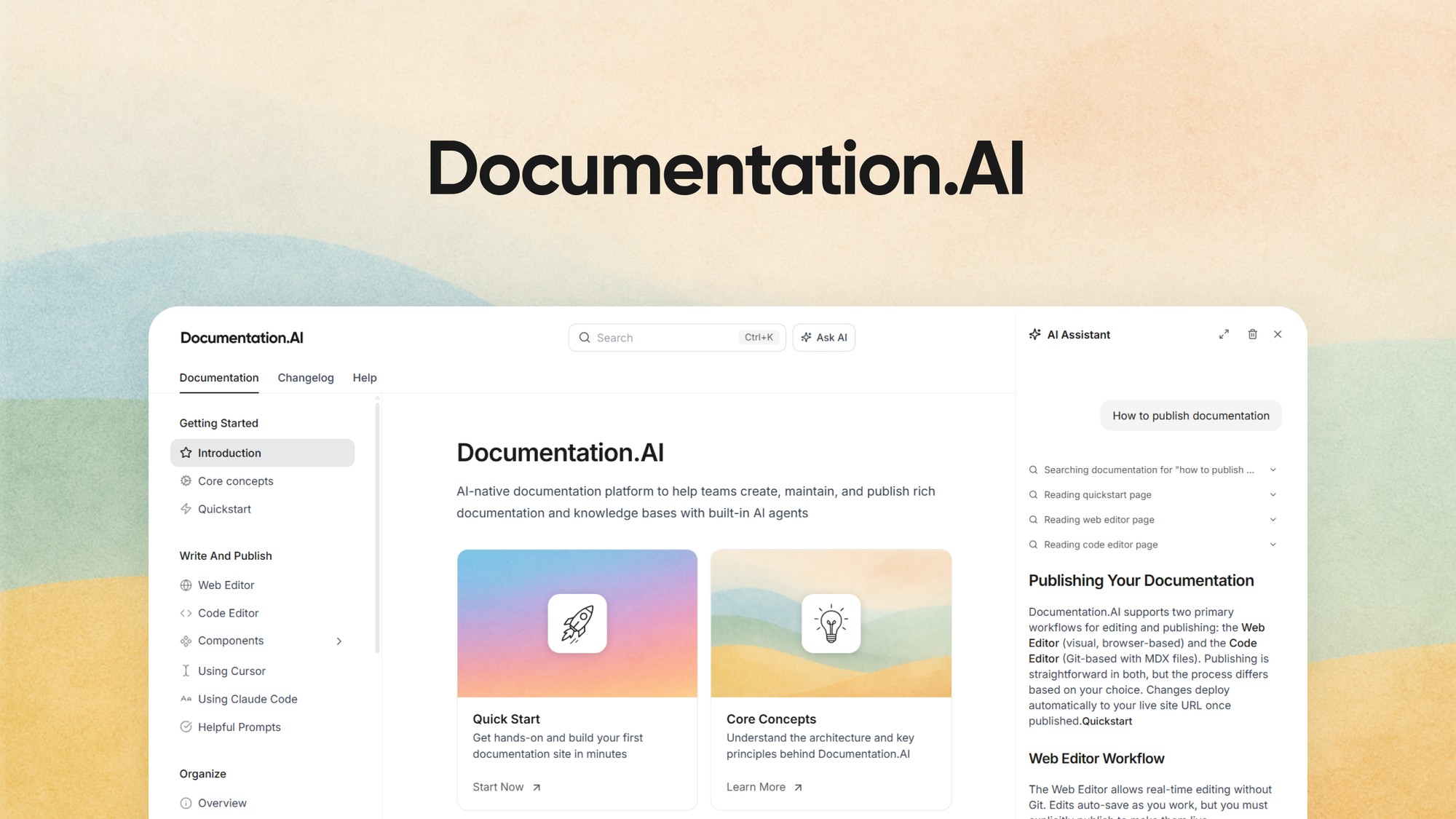
Documentation.AI is a hosted platform for creating, publishing, and maintaining documentation. It combines a visual editor and MDX editing with Git synchronization, custom branding, and an embedded AI assistant.
The assistant answers questions inside your documentation and cites its sources. For developers, the platform imports OpenAPI specifications to create API reference pages, code examples, and an interactive playground.
Its documentation agent helps generate and refresh content. The platform also provides llms.txt and MCP capabilities intended to make documentation accessible to AI tools. The founder describes fully self-maintaining documentation as an ongoing goal, so human review remains important.
Key facts
One-time price: $69, $149, $269, or $549, depending on the license tier.
Access: Lifetime access.
Replaces: A hosted product documentation, API documentation, or help-center subscription.
Refund window: Refundable up to 60 days.
Tier structure: Four selectable license tiers.
Published limits: Editor seats, monthly AI credits, documentation sites/projects, and total storage.
Pages and readers: Unlimited across all four tiers.
The AppSumo refund policy guide provides useful context for planning your evaluation within that window.
What the payback looks like
Using the reviewer’s $65 monthly comparison, Tier 1 pays for itself in just over one month. Tier 2 takes a little over two months, and Tier 3 takes a little over four months. Those are excellent payback periods if the platform genuinely replaces that subscription.
Tier 4 takes a little over eight months. That is a good return if your team uses it weekly and needs the additional capacity. If you currently publish documentation for free, there is no subscription saving to recover. The decision becomes about convenience and maintenance time, as discussed in our lifetime deal versus subscription guide.
What you actually get
Publish docs without managing the whole stack
The visual editor, MDX editor, live preview, reusable snippets, and built-in components support documentation authoring. Custom domains, themes, colors, and CSS let you adapt the published site to your brand.
For teams paying for hosted documentation today, this is the core replacement job.
Answer questions where users need help
The embedded assistant supplies answers with citations. Page feedback and assistant analytics help identify missing explanations or confusing content.
This gives support teams a way to improve documentation around actual questions, without assuming every visitor will find the right page unaided.
Turn API specifications into usable references
OpenAPI imports generate organized reference pages and code samples. The interactive API playground lets readers test endpoints and adjust parameters, while multilingual request examples make implementation easier.
That reduces the work involved in maintaining a separate API reference alongside general product documentation.
Connect documentation to development
Bidirectional Git sync and preview deployments support a repository-based workflow. The documentation agent helps generate and refresh content, while llms.txt and MCP capabilities support access by AI tools.
These features matter most when documentation needs to evolve alongside code changes.
Find where readers struggle
The listing describes analytics for page views, search terms, and drop-offs, alongside feedback collected directly on pages. These can guide revisions toward material users actually need.
Tiers and limits
The deal uses direct license-tier selection. Choose the capacity you need rather than assuming an entry purchase can later be expanded through code stacking. Our guide to AppSumo codes and stacking explains that distinction.
| Tier |
One-time price |
Editor seats |
AI credits monthly |
Sites/projects |
Storage |
| Tier 1 |
$69 |
5 |
5,000 |
2 |
5 GB |
| Tier 2 |
$149 |
10 |
10,000 |
2 |
10 GB |
| Tier 3 |
$269 |
20 |
20,000 |
4 |
20 GB |
| Tier 4 |
$549 |
Unlimited |
40,000 |
10 |
50 GB |
All four tiers list unlimited pages and readers.
The limits do not rise evenly. Tier 2 doubles seats, credits, and storage but keeps the same two-project limit as Tier 1. Tier 3 increases projects to four. Tier 4 removes the editor-seat limit, but projects remain capped at ten and AI credits at 40,000 per month.
Things to weigh
Git publishing needs a practical test. One reviewer reported that updated content appeared in the editor but remained stale on the live site until a minor edit triggered publishing. The founder said active Git connections should publish main-branch changes automatically and offered to investigate.
Credits and projects can constrain growth. Unlimited readers do not mean unlimited AI usage or unlimited documentation sites. Match the tier to your expected workload.
Some ambitions remain on the roadmap. Founder replies discuss future screenshot, video, and interface-translation work. Base your purchase on current functionality, rather than treating those plans as delivered features.
Before you buy
- Test your actual migration path. For API documentation, import a representative OpenAPI specification. For repository-based docs, connect GitHub and check formatting.
- Push an update through your normal workflow and confirm it reaches the live site. Include a test involving editor changes.
- Ask how AI credits are consumed by the assistant and documentation agent, then compare typical usage with your chosen tier.
- Confirm the availability and tier eligibility of required integrations, private documentation, external assistant sources, and PDF export.
These are practical examples of the checks to make before buying a lifetime deal.
Who it suits, and who should look elsewhere
Who it suits
- Small product teams maintaining a help center or product documentation.
- Developers who want OpenAPI references and Git-connected publishing.
- Support teams that want cited answers inside their documentation.
- Businesses replacing a paid documentation platform with predictable capacity needs.
Who should look elsewhere
- Organizations needing more than ten documentation sites. A subscription with sufficient project capacity would be a better fit.
- Teams requiring features the founder still describes as future work.
- Buyers whose existing documentation setup already meets their needs at no recurring cost.
Verdict
Tier 1 is a sensible starting point for a small team with one or two documentation sites. Tier 2 makes sense when seats, credits, or storage are the constraint. Tier 3 is the first option that increases project capacity, while Tier 4 suits larger editorial teams managing up to ten sites.
The strongest case is replacing an existing documentation bill. The main cautions are publishing reliability, AI-credit fit, and dependence on the vendor continuing to operate. The founder lists a bootstrapped team of 1–10 people; that does not establish whether the service will still meet your needs three years from now. Our guide to lifetime-deal advantages and risks puts that trade-off in context.
Activate access promptly after purchase and begin testing immediately. Set day fifty after purchase as your decision deadline, leaving time within the stated 60-day refund window.
Not sure yet?
Run this deal through our free scorecard. Seven checks, a payback calculator, and a plain verdict on whether to buy.
Get the Lifetime Deal Scorecard, free
FAQ
Is Documentation.AI a lifetime purchase?
Yes. The listing offers lifetime access through four license tiers, starting at $69.
Does Tier 4 include unlimited projects?
No. Tier 4 includes unlimited editor seats, ten documentation sites/projects, 40,000 monthly AI credits, and 50 GB of storage.
Are pages and readers limited?
The listing specifies unlimited pages and unlimited readers across all four tiers. Other limits still apply.
Can it generate API documentation?
Yes. It imports OpenAPI specifications to generate reference pages and code samples, with an interactive API playground for testing endpoints.
Does the AI assistant cite its answers?
Yes. The listing describes an embedded assistant that answers user questions with cited sources.
Can I get a refund?
The listing states that the purchase is refundable up to 60 days and covered by AppSumo’s We Got Your Back guarantee.